


AI anxiety is creating a new cross-party consensus. The prescription? New taxes. Andrew Yang wants a tax on computing power. Bill Gates wants the robot that takes your job to pay taxes. Nobel laureate Simon Johnson calls a compute tax “a sensible policy lever to consider in order to slow down automation.” President Trump wants AI firms to “give something back to the public.”
The proposals differ in detail, but they cite the same story: Labor’s share of national income has declined, and AI is accelerating workers’ losses by shifting more economic activity to capital. The tax code makes all of this worse by undertaxing capital relative to labor.
Every part of that story is wrong.
Capital Versus Labor?
The capital versus labor story is ubiquitous. In an October 2023 interview before he became Treasury secretary, Scott Bessent claimed that “capital has gotten treated better to the detriment of labor” since the 1980s.
The AI optimists tell a version of the same story. Sam Altman, CEO of OpenAI, fears that AI could “break capitalism” through a “shift of leverage from labor to capital” and undermine the role of traditional work in our economy. Anthropic CEO Dario Amodei regularly cites similar concerns.
In theory, productivity-increasing technologies can replace or complement human labor. New technologies have always replaced some jobs, but in the process, they have created entirely new industries, expanded overall output, and enhanced the value of human inputs and, thus, their wages.
As I explain in a new piece for GIS Reports, the labor is losing to capital story does not show up in the data:
In standard economic models, output is attributed to the combination of labor, capital and technology. Each component can be thought of as earning a share of national income. If, over time, capital became more important for economic output, capital’s share of national income would increase. Empirical evidence does not support this claim.
Figure 1 (below) uses data from the United States Bureau of Economic Analysis to show that the labor share of net income (net of taxes and depreciation, which better captures income actually available to workers and capital owners) is within its historical range, fluctuating above and below the average of 69 percent. Labor’s share rose gradually from the mid-20th century through the early 2000s, declined modestly thereafter and has since returned near its historical average.
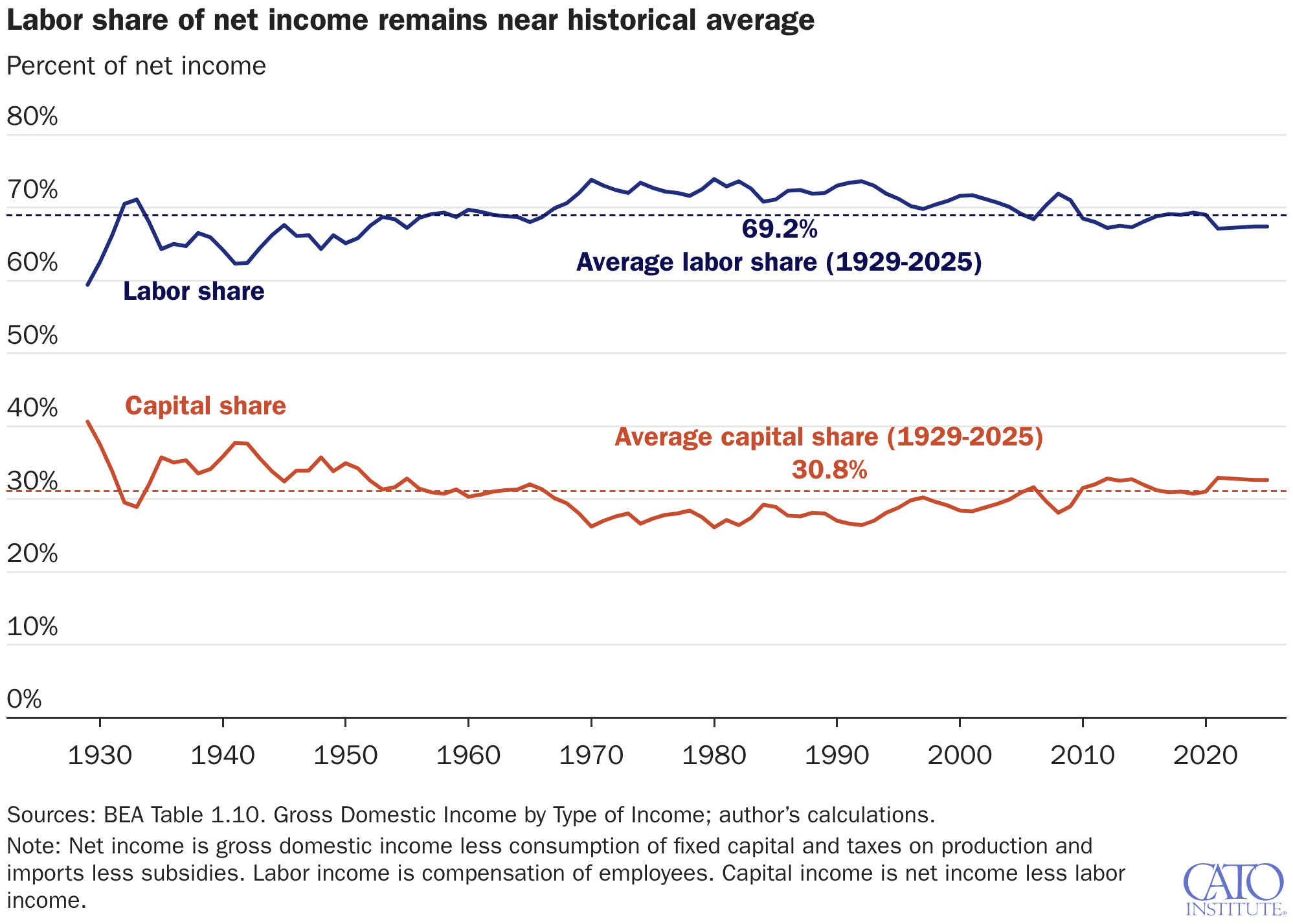
The entire framing that labor and capital are locked in a zero-sum fight over income misinterprets how production has historically worked. Empirical research consistently finds that investment in new technologies is complementary, primarily augmenting, not replacing, work. One recent review suggests that a 1 percent increase in capital per worker raises wages by about 3 percent.
Certainly, the future could be different. But even in a world where capital’s share of national income rises, it does not necessarily follow that workers are made worse off. Workers can still benefit from increasing wages in a growing economy, even if capital’s share is growing faster. If everyone is getting richer, then who is getting richer faster is, at most, a secondary concern. The primary economic problem is not one of simply dividing existing resources but of making more goods and services from fewer resources.
Even on Its Own Terms, a Compute Tax Fails
Suppose you believed that this time is actually different and workers are about to be displaced by machines, without any offsetting new jobs. Economist Brian Albrecht concludes that “a compute tax is about as bad as a tax can be.”
First, a tax on inputs to the AI process, such as graphics processing units, power generation, and data centers, is a tax on intermediate goods. Because AI is increasingly an input into other firms’ production, taxing AI’s inputs raises costs before any final good or service is produced. Those higher costs then pyramid through downstream products. The result is a hidden, arbitrary tax on final outputs that varies with the number of production stages and rewards firms for minimizing taxable inputs rather than for producing efficiently. These types of intermediate taxes are some of the most economically damaging ways to raise revenue.
Second, most of the inputs to AI that could be taxed are capital, and capital taxes are notoriously shifted from owners to workers through lower investment, slower productivity growth, and, ultimately, lower wages. As Albrecht notes, “The features of AI that people worry about (easy substitution between capital and labor, mobile capital, self-replicating infrastructure) are exactly the features that make capital taxation counterproductive.” For workers to succeed in an AI economy, they will need more investment in newer and better tools, not less. Taxing the capital behind those tools would slow the very process that can raise wages and expand opportunity.
Third, the AI capital tax base is too small and too elastic to raise significant revenue. Beyond punishing the AI technology directly, proponents often frame the taxes as raising revenue for new programs or tax cuts for impacted workers. One optimistic scenario projects $1.4 trillion in AI spending next year. Even at a 100 percent tax rate, with no behavioral effects, the revenue wouldn’t even cover the current federal budget deficit, let alone new income support programs, additional redistribution, or tax cuts for workers. And anything near 100 percent tax rates would dramatically shrink projected AI spending and, thus, expected revenue. AI development wouldn’t stop; it would just shift offshore. The result would be less domestic investment and fewer American workers building and using the next generation of productivity-enhancing tools.
Is Capital Undertaxed?
The popular narrative behind AI taxes is that the tax code already overtaxes labor and undertaxes capital. Putting numbers to this, Economists Daron Acemoglu, Andrea Manera, and Pascual Restrepo estimated that labor faces an effective tax rate around 25 percent while equipment and software face rates closer to 5 percent. Garrett Watson at the Tax Foundation details a number of reasons why we should be skeptical of this analysis, as do the commentators on the paper itself, noting numerous methodological flaws. I will highlight several places where this comparison misses the mark.
On the input side, wages are 100 percent deductible the year they are paid (called “expensing”). It is often claimed that extending the same treatment to capital is a tax subsidy. It is not a subsidy; it is equal treatment.
Expensing brings deductions forward in time, shifting taxes paid into the future. The low capital tax figure reported by Acemoglu et al. is largely driven by failing to properly account for this artifact of timing. Following the 2025 tax package, equipment, research and development, and manufacturing structures are eligible for immediate deductions and are at parity with labor. Nonmanufacturing structures are still disfavored and must be depreciated over three to four decades. So, on this margin, there is no systematic bias toward capital.
The only significant tax asymmetry that remains in a firm’s decision between capital and labor is the employer-side payroll tax. Economists generally assume that the economic cost of the tax falls overwhelmingly on workers through lower take-home pay and not on a firm’s owners. Given equal outputs, firms compare total compensation costs to total machine costs. If payroll taxes are largely capitalized into wages, the tax is not a penalty on firms employing humans; it is, however, a tax that changes worker behavior.
The same logic applies on the output side, where the relevant comparison is between the taxes that distort workers’ decision to work and savers’ decision to invest. Labor income is taxed by the income and payroll taxes. Across both taxes, the US Treasury Department estimates the average federal tax rate on labor at 17 percent. The top marginal statutory rate is 40.8 percent.
The return on invested capital in public markets is subject to taxes at the entity and investor levels. Corporate profits are taxed at 21 percent, and the remainder is taxed again at rates up to 23.8 percent when paid out as dividends or realized as capital gains. Combined, the top statutory federal tax rate is roughly 40 percent on the return to corporate equity. Economist Kyle Pomerleau finds that average effective tax rates on investment differ by business form and financing source but generally fall between the mid-20 percent and mid-30 percent range.
By most careful measures, capital and labor face roughly similar overall tax burdens. But the comparison is somewhat incoherent. A tax on the normal return to capital (the return just sufficient to make the investment worthwhile) is a second tax on saved wages, distorting when to consume rather than whether to work. A tax base that is neutral to the saving-consumption decision would exempt the normal return and tax supernormal returns at the same rate as wages.
This is also why a new tax on AI is unnecessary to capture its gains. Existing taxes on corporate profits and capital income already capture the types of supernormal returns that could come from high-growth AI scenarios. There are many ways to improve the tax system to ensure supernormal returns are fully taxed and increase parity among wages, consumption, and saving. But removing full immediate expensing or indiscriminately raising tax rates on capital income, tokens, or compute will do more harm than good.
AI will most certainly change the labor market. But it has not yet changed the complementary relationship between workers and the tools that make them more productive. Taxing the machines is simply a softer version of the Luddite English textile workers who sought to destroy the machines that were necessary for our modern world. An AI or capital tax would fall on the very workers the policy is intended to help.