

86% are grateful to be American, 70% say Founding principles remain relevant today, 57% say the US has moved away from its founding principles, 56% worry the US could lose its freedom over the next 50 years. 58% say no political party should be trusted with too much power.

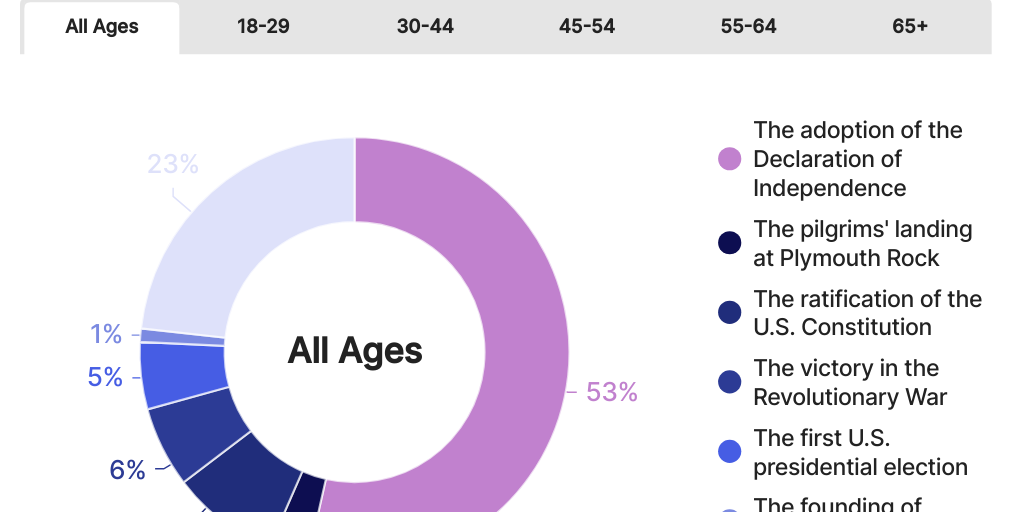
A new national survey from the Cato Institute, conducted in collaboration with Morning Consult of 2,253 Americans ahead of July 4th and America’s 250th anniversary, finds nearly half (46%) of Americans don’t know what America’s 250th anniversary commemorates. A little more than half (53%) correctly answered that it was the adoption of the Declaration of Independence.
Despite civic ignorance, overwhelming majorities are grateful (86%) and proud (79%) to be Americans. Most also believe America is a land of opportunity (61%), and even more believe the American Dream (74%) is available to them personally. As the nation celebrates its birth, most Americans feel positive (76%) about the nation’s founding, and 70% believe its founding principles remain relevant today. In particular, overwhelming majorities believe the US Constitution is important for protecting our rights and freedoms (86%) and for enabling America’s prosperity (82%).
However, nearly 6 in 10 believe the country has moved away from the founding principles, and 56% worry the US could stop being a free country within the next 50 years. People believe corruption, concentrations and abuse of power, and ignoring founding principles could lead to the country’s demise. Americans support constitutional limits, dividing power, and checking the power of the president to maintain their freedoms. For instance, 58% say no political party should be trusted with too much power, 55% say the US Constitution should place firm limits on what the government is allowed to do, even if it makes it harder to solve problems, and 72% say the president should have to obey Supreme Court rulings even when he disagrees.
Yet, a significant minority is willing to bend the rules when it suits their advantage. Four in 10 Americans think it’s acceptable if a president they support stretched the Constitution to get what they want.
Another risk to the country is low substantive civic knowledge on basic governance questions. For instance, while 77% know George Washington was the first president, 58% don’t know what the main purpose of the US Constitution is, and 57% don’t know the reason we declared independence from Great Britain and created our government with limited powers.
Capitalism (52%) is viewed somewhat more favorably than socialism (37%). However, people are evenly divided on socialism, with equal shares who are favorable and unfavorable. Gen Z stands out with more who are supportive of socialism (53%) than capitalism (45%). The survey found the “Democratic Socialist” label can both help and harm a candidate about equally. While 39% said they’d be more likely to vote for a Democratic Socialist candidate, 40% said they’d be less likely, and 22% weren’t sure either way. Democrats (61%) and Gen Z (51%) reported they’d be likely to vote for a candidate with the Democratic Socialist label.
America’s 250th
Nearly half (46%) of Americans—and nearly two-thirds (61%) of Gen Z—don’t know what America’s 250th commemorates. A little over half (53%) of Americans and 39% of Gen Z correctly identified that the adoption of the Declaration of Independence in 1776—250 years ago—is the reason for this year’s celebration.
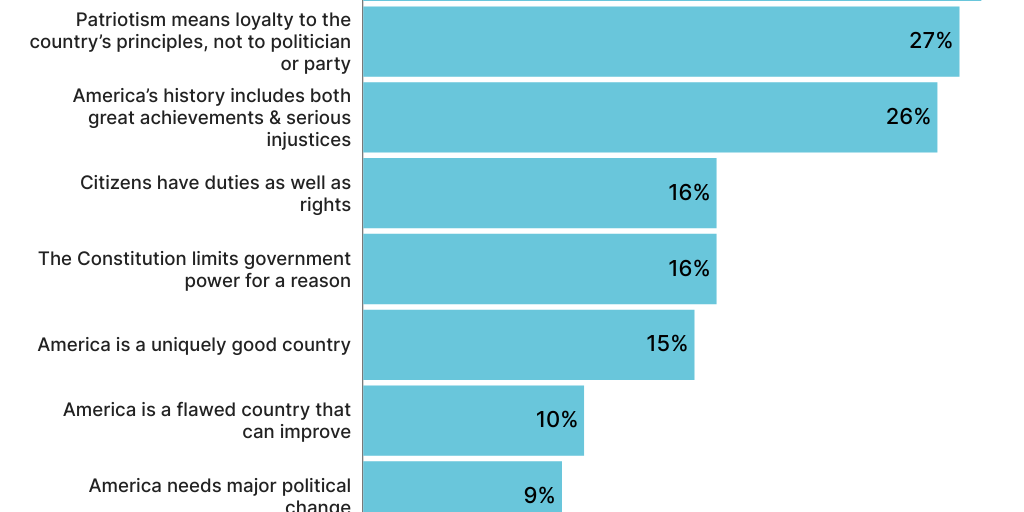
When asked what people would most like children to learn from America’s 250th anniversary, Americans identified three top priorities: to teach (1) that freedom is rare and must be protected (28%), (2) that patriotism means loyalty to the country’s principles, not to any politician or party (27%), and (3) that America’s history includes both great achievements and serious injustices (26%).
Attitudes toward the American Founding
Although many Americans don’t know we’re celebrating the birth of the United States, most have an overwhelmingly positive view of our country and of what the Declaration of Independence made possible. Nearly 9 in 10 (86%) of Americans are “grateful” to be Americans, and 79% are “proud” to be Americans. Furthermore, most believe America offers them a chance to rise: nearly two-thirds (61%) believe America is the “land of opportunity,” and 74% believe the American Dream is available to them.
More than three-fourths (76%) of Americans have a favorable view of the founding of the United States, including 51% who have a strongly favorable view of it. Even 250 years later, 70% also believe the principles of the country’s founding remain relevant today.
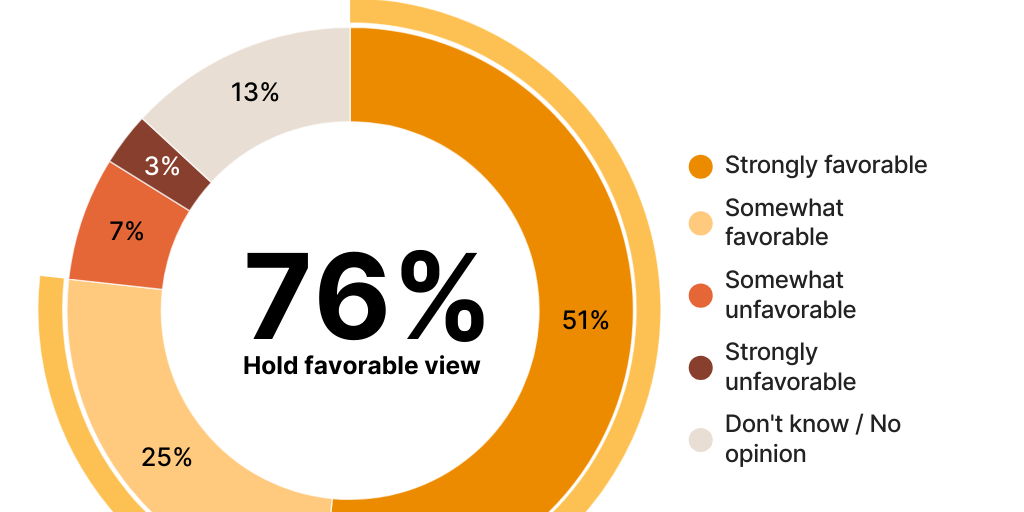
Appreciation for the founding is not strongly partisan. Majorities of Democrats (81%), Republicans (86%), and independents (64%) all have a favorable view of the nation’s birth. Similarly strong majorities of Democrats (72%), Republicans (83%), and independents (58%) also believe the founding principles remain relevant. Nevertheless, Republicans have more intensely held views, with 67% who feel very favorable toward it and believe the principles definitely remain relevant (58%), compared to 49% of Democrats who feel very favorable and believe the founding principles definitely remain relevant (42%).
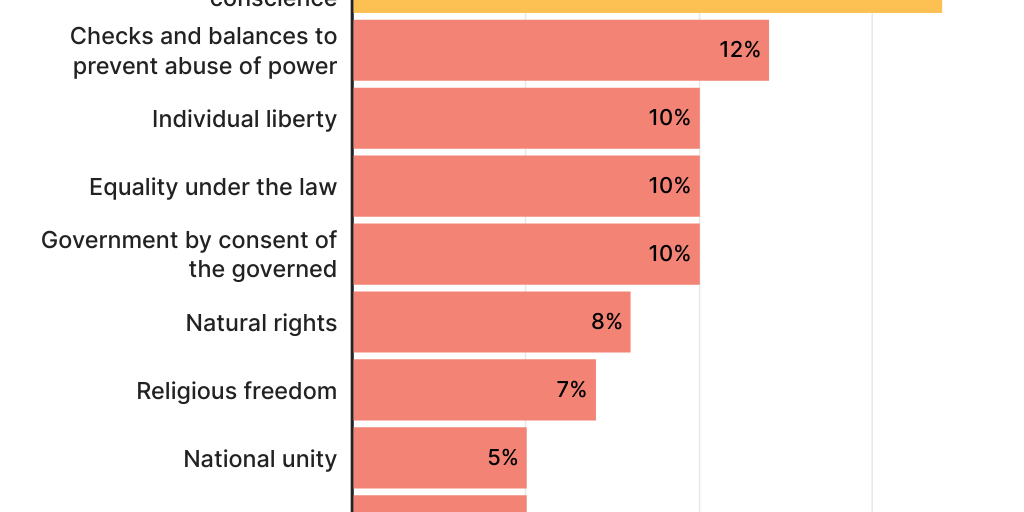
When asked which principles and ideals were the most important behind the American founding, no consensus around one single principle emerges. The plurality selected freedom of speech and conscience (17%) as the most important idea, followed by checks and balances to prevent abuse of power (12%), individual liberty (10%), equality under the law (10%), and government by the consent of the governed (10%). Other less popular responses included natural rights (8%), religious freedom (7%), national unity (5%), traditional values (5%), and free enterprise and private property (3%), with 14% unsure.
Attitudes toward the American Founders
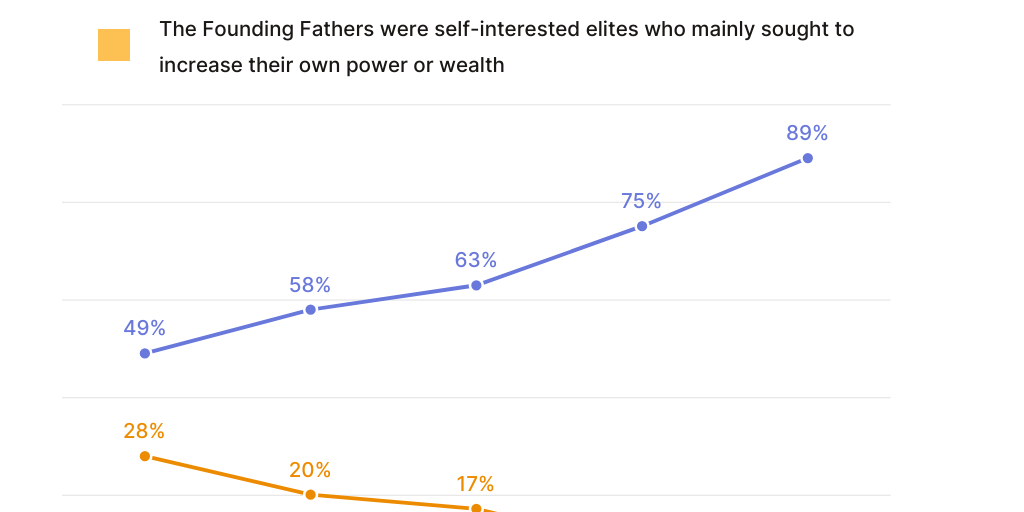
Most Americans also feel favorable toward the country’s founders. Most Americans (67%) say they view the Founding Fathers as “courageous leaders who risked their lives and possessions to secure independence and liberty,” while 16% say they view them as “self-interested elites who mainly sought to increase their own power or wealth,” and 18% weren’t sure either way.
Young Americans are much less likely than older Americans to have strongly positive views of America’s founding. Seniors (Americans over 65) are 36 points more positive than Americans aged 18–29 (94% vs. 58%). Part of the reason for the difference is that 20% of Gen Z say they don’t know enough about the founding to have an opinion, compared with 4% of seniors. But that’s not all.
A little less than half (49%) of Gen Z agree that the Founding Fathers were courageous leaders who risked their lives and possessions to secure independence and liberty, compared to the vast majority (89%) of seniors—a 40-point difference. Young Americans are 7 times as likely as seniors to adopt a revisionist argument that the Founding Fathers declared independence from Britain mainly to increase their own power and wealth (28% vs. 4%).
Threats to Founding Principles
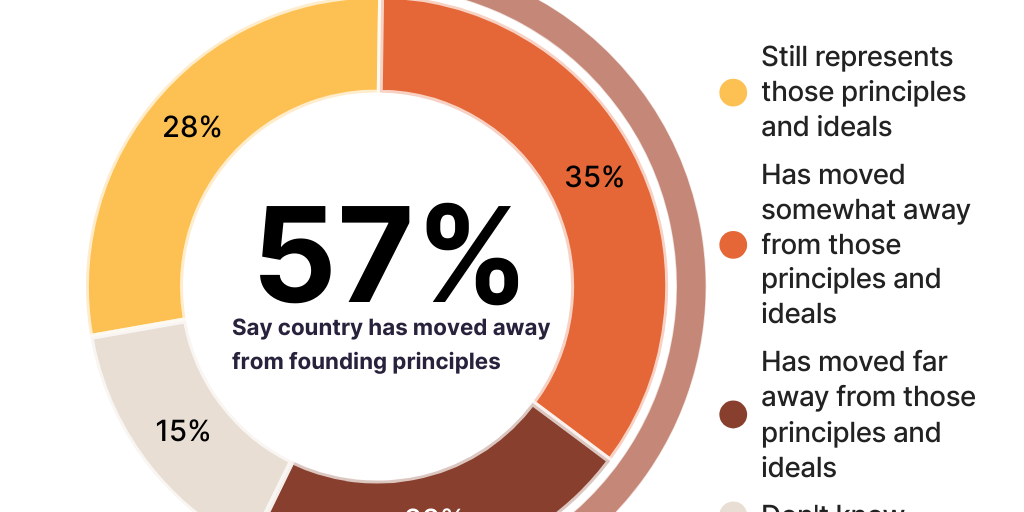
A majority (57%) believe the country has moved away from the principles and ideals upon which it was founded, including 22% who think the country has moved “far away,” and 35% who think it has moved away “somewhat.” This presents a contrast between the 70% that believe the principles of the founding are still relevant today and the 57% that believe we have strayed from those same principles.
Looking ahead to the next 250 years, Americans believe that certain cultural and economic changes are necessary to help the country succeed, namely, reducing corruption and special interest influence (31%); lowering the cost of living (31%); having better political leaders (28%); having a stronger economy (27%); and having respect for the Constitution (21%). Respondents also identified improving Americans’ personal ethics and character (20%), stronger families and communities (19%), better schools and job skills (17%), less government debt (17%), more national unity (17%), better civic education (10%), and more individual freedom (9%) as essential to help the country thrive over the next few centuries.
Heirs to the American Founding
No one alive today participated in the founding-era congresses and conventions that declared American independence, framed the Constitution, and ratified our system of government. Yet most Americans still feel that they are rightful heirs to that founding—that its promises, principles, and responsibilities belong to them, too. More than 7 in 10 Americans (71%) believe that the ideals and institutions of the American founding are “part of their inheritance as an American.”
While a majority of Americans feel a connection to the country’s founding, the strength of that connection varies widely across demographic groups. The starkest difference is a generational one, as a 33-point difference appears between seniors (88%) and Gen Z (55%) who feel the founding ideals are part of their inheritance. Wealth and education also divide the sentiment, as higher-income Americans (87%) and postgraduates (84%) significantly outpace their respective counterparts of lower-income Americans (63%) and those without a college degree (66%). Race and immigration status likewise draw differences. White Americans (77%) are 15 points more likely than Hispanic Americans (62%) and 18 points more likely than Black Americans (59%) to feel this way. Likewise, native-born Americans (74%) are 17 points more likely than immigrants (57%) and 11 points more likely than 2nd-generation immigrants (63%) to feel they also are heirs to the American founding. Even by gender, men (78%) are 12 points more likely to feel this connection to the founding than women (66%).
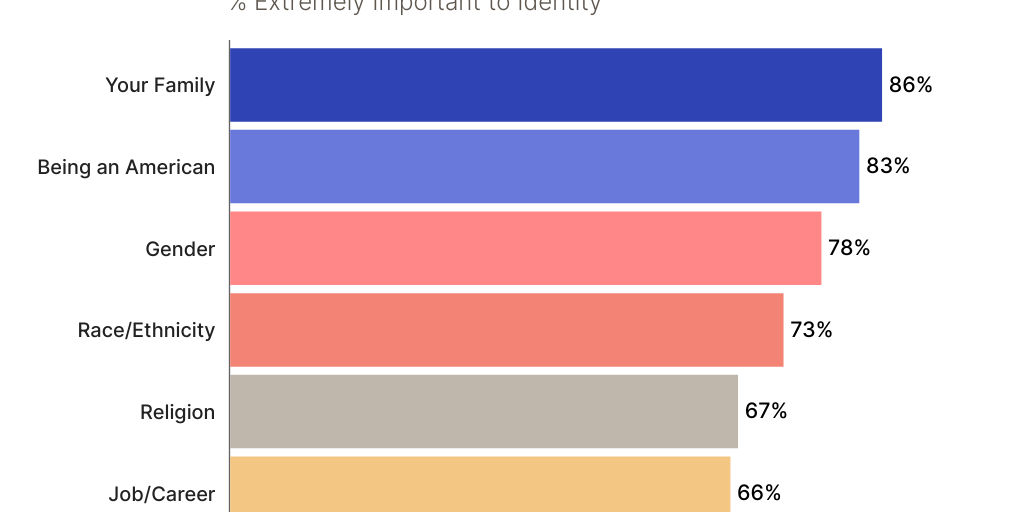
Being an American is a significant part of most people’s personal identity, second only to their family. The survey found that people defined their identity first around being part of their family (86%), then being an American (83%), their gender (78%), their race or identity (73%), their religion (67%), their job or career (66%), and then their political affiliation (62%). This suggests that American identity has the capacity to transcend racial, religious, and gender divisions and offer people something they have in common.
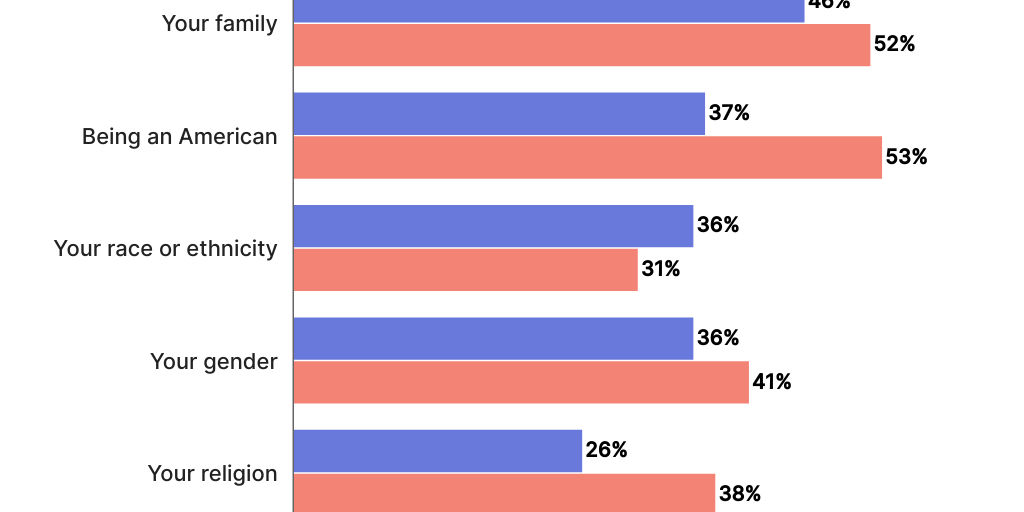
Republicans are relatively more likely than Democrats to base their identity on their family (52% vs. 46%), country (53% vs. 37%), and religion (38% vs 26%). For Democrats, their American identity contributes about the same as their race or gender.
1619 Project
The survey also assessed the extent to which people have come to believe a hypothesis put forth in the 1619 Project: that preserving slavery was a primary reason the American Revolution was fought. The survey found a little more than a third (36%) believe this claim, while 39% believe it’s not true, and about a quarter (26%) aren’t sure if it’s true or not true.
This idea has strongly permeated among the nation’s youth. Young people are more than twice as likely to believe this is true (47%) as to believe it is untrue (21%). This stands in stark contrast to seniors, of whom just 18% believe it is true, compared with 64% who believe it is untrue. Democrats (46%) are also more likely to believe it than Republicans (36%) and independents (25%).
Black Americans (51%) are also far more likely to believe this than not (22%), compared to white Americans who believe it (29%) versus not (46%). Hispanic Americans fall in between, but more believe this (43%) than don’t (30%).
The US Constitution
Nearly 8 in 10 Americans (79%) say they have a favorable view of the US Constitution, 7% have an unfavorable view, and 15% aren’t sure what they think. Overwhelming majorities of Republicans (88%) and Democrats (83%) have a favorable view of it. However, Democrats have conflicting feelings about it and thus are less strongly favorable (45%) toward it than Republicans (64%).
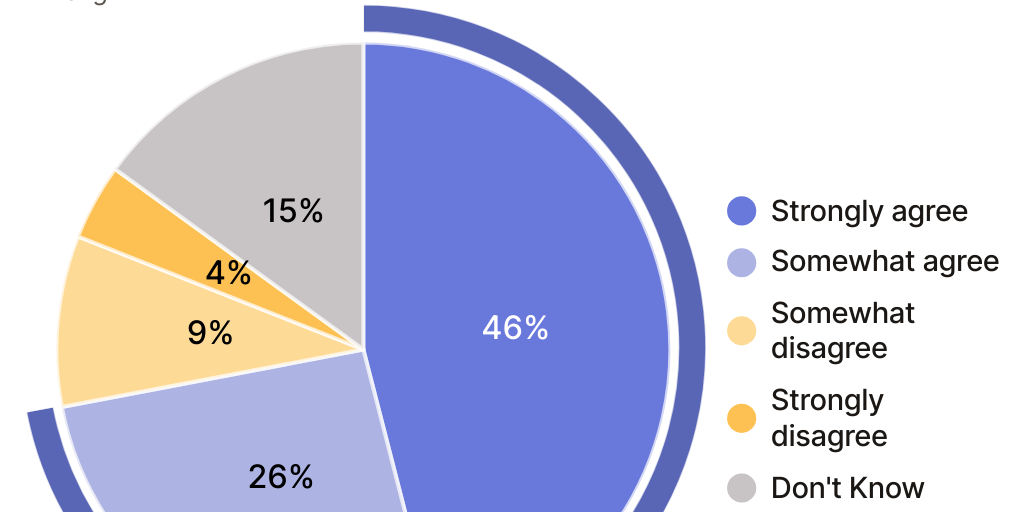
Most Americans (82%) believe the US Constitution was important for America becoming a prosperous country, and a similar share (86%) view the Constitution as important for protecting their liberty and freedoms—including 46% who believe it’s extremely important, 28% who say it’s very important, and 12% who say it’s somewhat important.
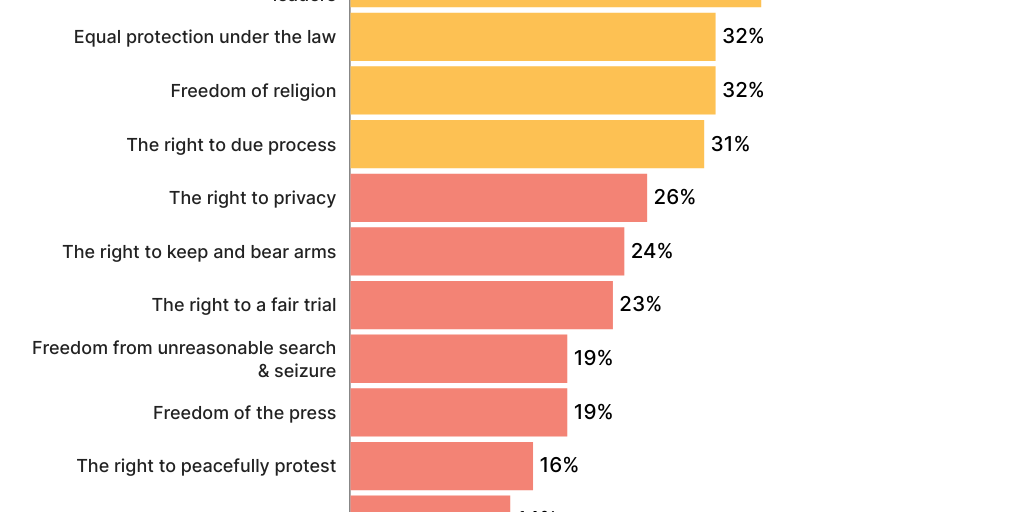
The top five rights and freedoms Americans value most include the freedom of speech (49%), the right to vote and choose our leaders (36%), equal protection under the law (32%), freedom of religion (32%), and the right to due process of law (31%).
However, while most Americans have at least an instinctive sense that the US Constitution protects their rights, a majority (58%) don’t actually know how it accomplishes this. Less than half (41%) correctly said that the Constitution’s purpose is to establish and limit the powers of government. The remaining said the purpose of the Constitution was to declare independence from Great Britain (17%), create the presidency, Congress, and Supreme Court (12%), list all federal laws (7%), or create two major political parties (4%), while 18% conceded they don’t know what the purpose of the Constitution is.
US Constitution: Protection or Hindrance?
A majority (55%) of Americans believe the Constitution should place firm limits on what the government can do, even when those limits make it harder to solve problems. About a quarter (25%) say the Constitution should be interpreted more flexibly so government can act more decisively and quickly to solve problems, while 20% aren’t sure either way.
Constitutional Convention
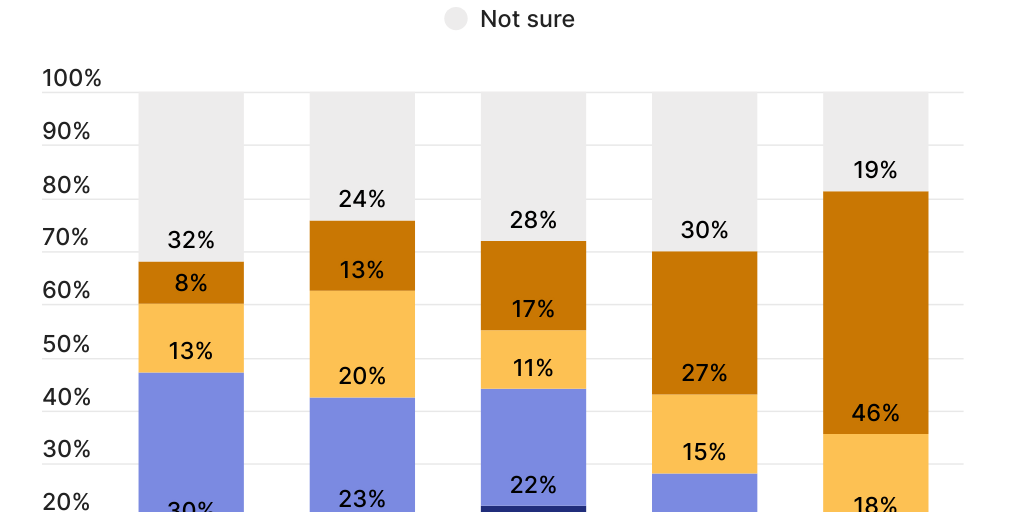
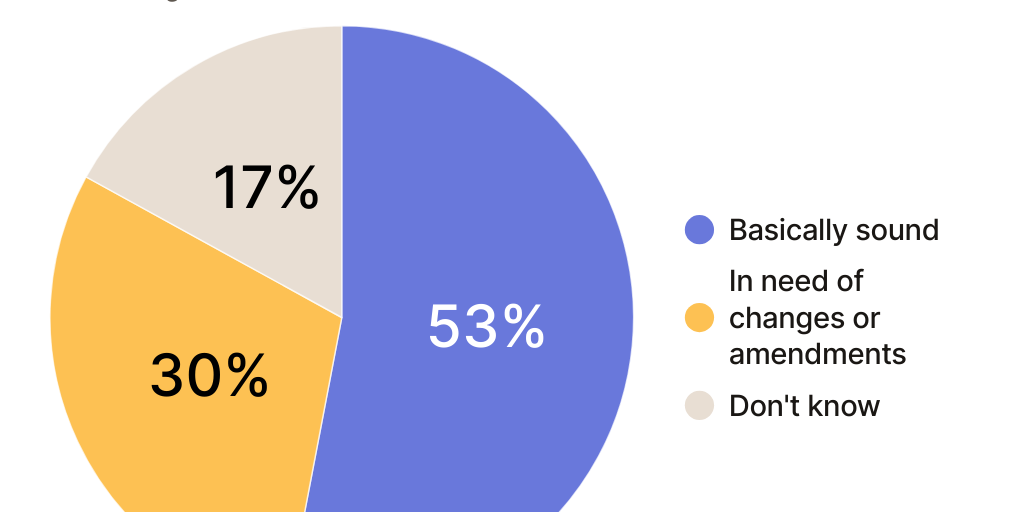
Nearly 250 years later, a slim majority (53%) of Americans believe the Constitution is still basically sound as is, while 30% think it’s in need of changes and 17% aren’t sure. Nearly a third (31%) would go so far as to say that we should start from scratch and write a “new American Constitution,” while a slim majority (52%) oppose writing a new constitution, and 16% aren’t sure. A little more than a third (38%) of Americans go even further, saying that we “cannot fix the problems in our government” and thus “we need to tear it down and start over,” while 45% disagree and 17% aren’t sure.
Majorities of both Republicans (58%) and Democrats (53%) oppose writing a new constitution. Gen Z stands out with more who would rewrite the Constitution (45%) than would not (33%), while 22% aren’t sure. In contrast, only 10% of seniors would rewrite the Constitution, and 82% would not, and 7% aren’t sure.
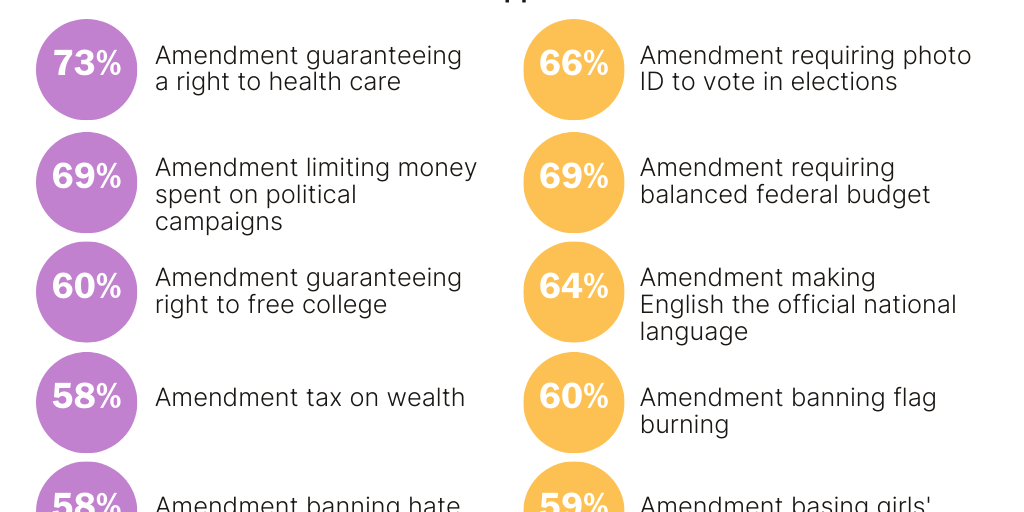
What if the country convened a new constitutional convention? The survey found that attempting to rewrite the Constitution could backfire on both sides. Strong majorities of Americans would support a wide variety of constitutional amendments that partisan political insiders oppose. For instance, majorities of Americans would support amendments to the Constitution that many Democratic political insiders would oppose:
- 66% support requiring photo ID to vote
- 69% support requiring a balanced budget amendment
- 64% support making English the official national language
- 60% support banning flag burning
- 59% support basing girls’ and women’s sports on sex at birth
Similarly, majorities of Americans would also support amendments to the Constitution that many Republican political insiders would oppose:
- Guarantee a right to health care (73%) and free college (60%)
- Limit money spent on political campaigns (69%)
- Protect a right to abortion (58%)
- Ban hate speech (58%)
- Allow a tax on wealth (58%)
Close to half (48%) would support allowing teachers to lead prayer in public schools, 41% would support abolishing the Electoral College, 38% would support ending birthright citizenship to the children of illegal immigrants, and 36% would support banning DEI in public schools.
America’s Future and Threats to Freedom
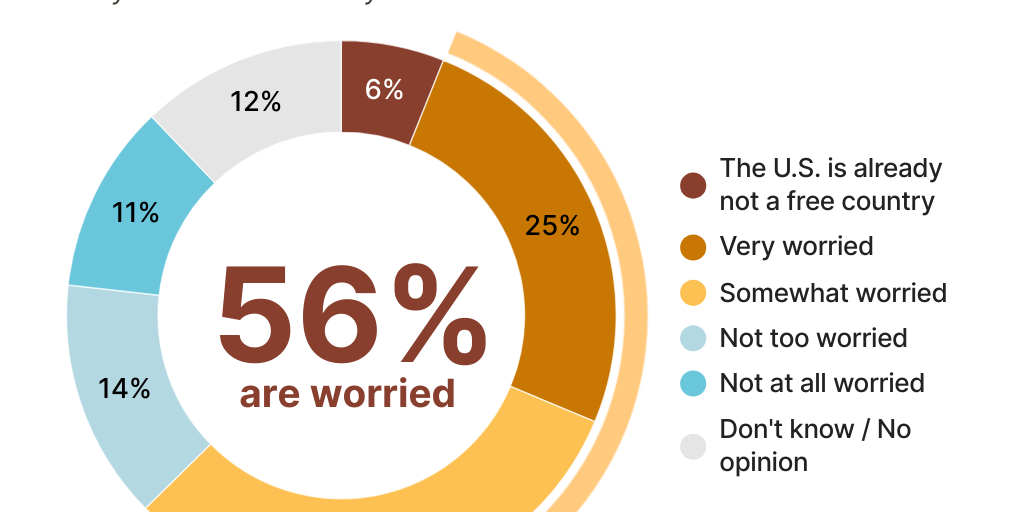
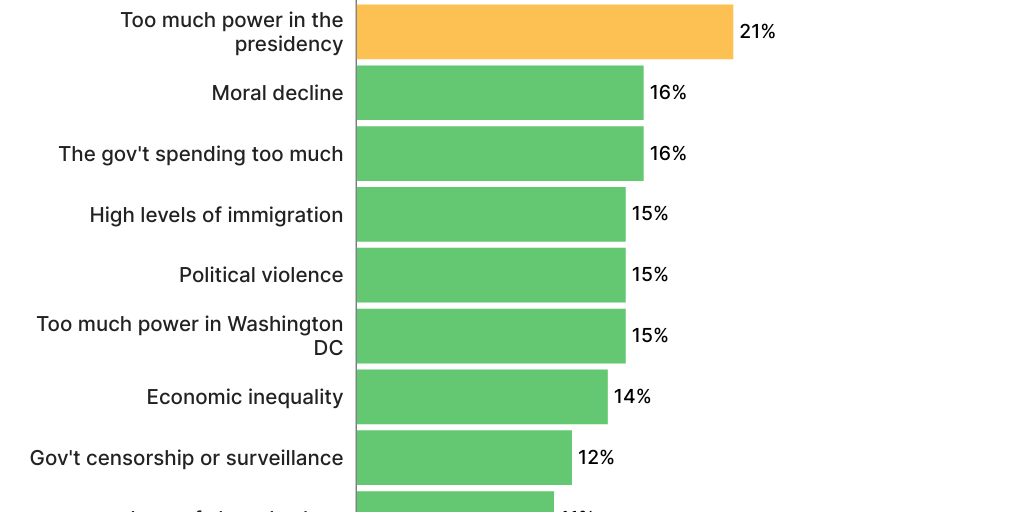
Thinking ahead to the next 50 years, a majority (56%) of Americans are worried that the US may stop being a free country. Majorities of both Democrats (65%) and Republicans (54%) are worried. When asked what are the greatest threats to America remaining a free republic, the most common answers given were abuses of power, concentrations of power, and ignoring the limits the Constitution places on power. The top four reasons include:
- Corruption 30%
- Politicians ignoring the Constitution (26%)
- The rich having too much power (24%)
- Too much power in the presidency (21%)
Other reasons given were moral decline (16%), excessive government spending and borrowing (16%), high levels of immigration (15%), political violence (15%), too much power in DC (15%), economic inequality (14%), government censorship or surveillance (12%), loss of shared values (11%), people refusing to accept election results (10%), and falling birth rates (6%).
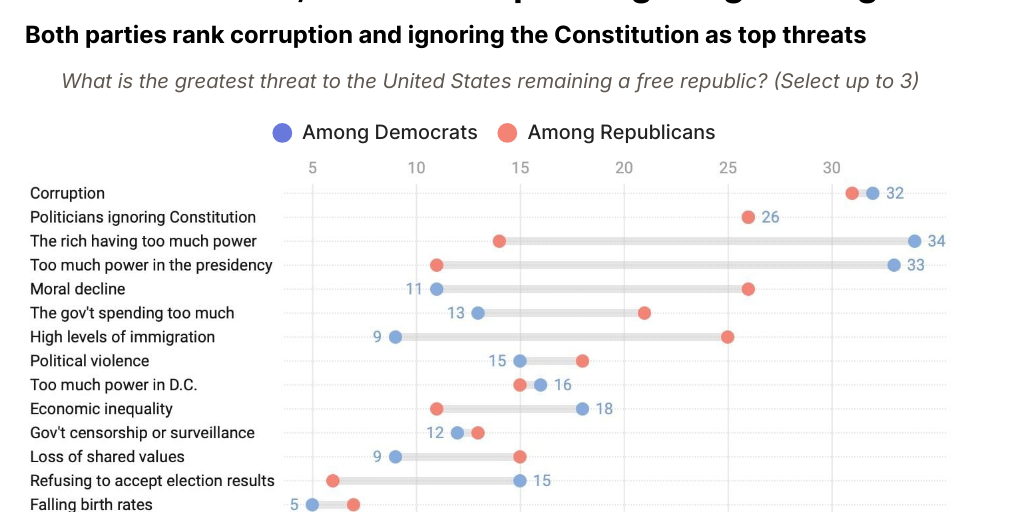
Republicans (31%) and Democrats (32%) both ranked corruption as a top threat, and equal shares of each party (26%) selected politicians ignoring the Constitution as a top threat to freedom. However, Republicans’ other top concerns were moral decline (26%), high levels of immigration (25%), and excessive government spending and borrowing (21%). On the other hand, Democrats were relatively more likely to believe that the rich having too much power (34%) and too much power concentrated in the presidency (33%) were top risks.
Americans also believe that personal ethics matter for retaining their freedom. Nearly 8 in 10 (77%) believe that for a country to remain free, “most people need to try to be good, honest, and responsible.” Majorities of Democrats (81%) and Republicans (82%) agreed.
Americans really don’t know if America’s best days are ahead of it or behind it; a plurality (41%) are optimistic that the nation’s best days are ahead of it, while about a third (35%) worry our country’s best days were in the past, and a quarter (24%) aren’t sure.
Attitudes are colored by partisanship, with a majority of Republicans (54%) who believe America’s best days are ahead and a plurality (44%) of Democrats who think the nation’s best days are behind us. Young Americans are also pessimistic, being the only age group with more who think America’s best days were in the past (40%) rather than in the future (35%). In contrast, 30–54 and 55+ are more optimistic than pessimistic about the country’s future.
American Exceptionalism
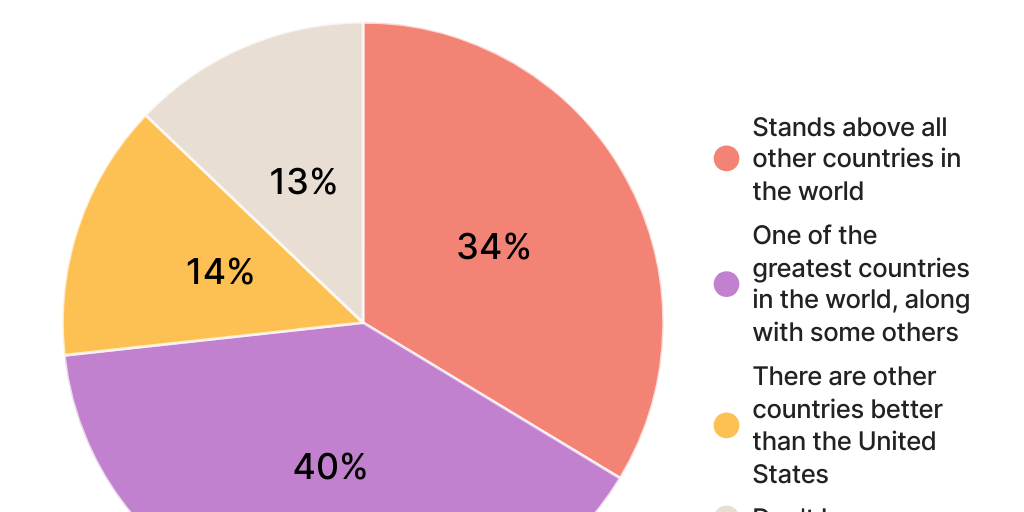
Majorities of Americans say they are proud (79%) and grateful (86%) to be Americans; however, far fewer believe in the idea of American exceptionalism. Only about a third (34%) believe that the United States “stands above all other countries in the world,” while 40% believe the US is “one of the greatest countries in the world, along with some others,” and 14% said there are other countries better than the US. Nevertheless, taken together, nearly three-fourths (74%) believe that America is among the world’s greatest countries.
The top core values and ideas that Americans believe define our country include
- Freedom and individual rights (33%)
- The Constitution (27%)
- The American Dream and opportunity to succeed (27%)
- Free Speech (25%)
- Democracy and elections (21%)
- Equality under the law (21%)
Other ideas and values that were less likely to be viewed as defining include religious freedom (15%), hard work and personal responsibility (13%), helping those in need (12%), patriotism (12%), capitalism and free enterprise (11%), faith and religion (11%), diversity and immigration (10%), and a shared American culture (7%).
American Dream
Nearly two-thirds of the public (61%) say that America is the “land of opportunity,” and even more–74%–say that they believe the American Dream is achievable for them personally. However, their confidence varies, with only 15% who think it is extremely achievable, 28% who say it’s very achievable, and 31% who say it’s somewhat achievable.
Nearly a third (32%) say America used to be a land of opportunity but no longer is today, and 7% say it never was. Somewhat fewer, about a quarter (26%), say they don’t believe the American Dream is attainable for them personally.
Both majorities of Democrats (53%) and Republicans (76%) believe the United States, more generally, remains a land of opportunity, but Democrats are less sure than Republicans. When it comes to their own personal experience, both Democrats (71%) and Republicans (82%) are more likely to think the American Dream is achievable for them than when assessing opportunity in the country overall.
Solid majorities of all racial groups believe America continues to be a land of opportunity, including White Americans (60%), Black Americans (60%), Hispanic Americans (61%), and Asian and other Americans (63%), as well as men (67%) and women (55%). A majority of Americans of all ages continue to believe the country offers great opportunity, but Americans under 30 (54%) are relatively less likely than those over 30 (62%) to feel confident.
One demographic group that stood out as not believing America is a land of opportunity: liberals. Slightly less than half (45%) compared to 74% of conservatives believe America is a place where people of any background can achieve a good life.
The Constitution as a Safeguard for Opportunity
Americans make a connection between the US Constitution and America being a prosperous country that offers opportunities to people. More than 8 in 10 (82%) of Americans believe that the US Constitution was very important (52%) or somewhat important (30%) for America becoming prosperous.
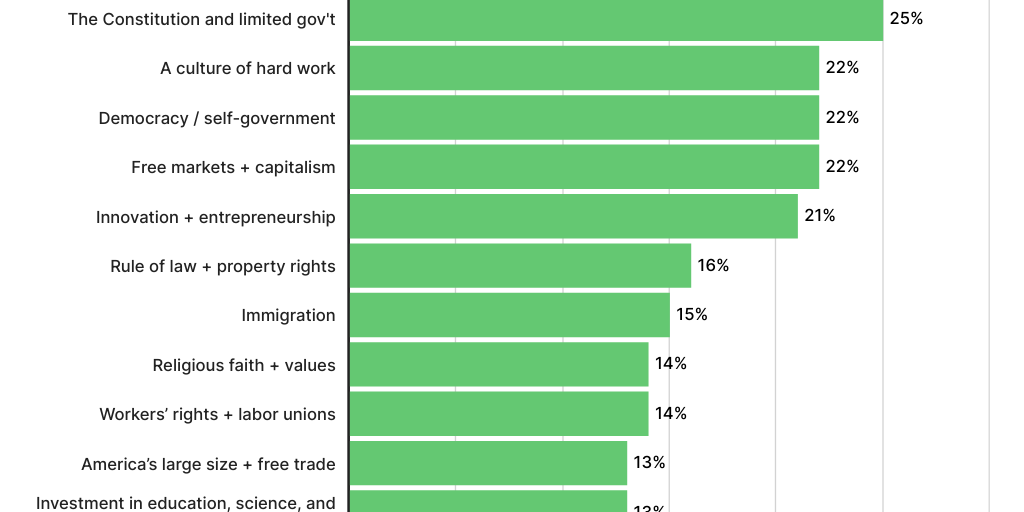
When asked what the reasons are why America became a prosperous country, people first choose combinations of freedom, capitalism, and a work ethic:
- The Constitution and limited government (25%)
- Free markets and capitalism (22%)
- A culture of hard work (22%)
- Democracy/self-government (22%)
- Innovation and entrepreneurship (21%)
Other reasons people selected include:
- Rule of law and property rights (16%)
- Immigration (15%)
- Religious faith and values (14%)
- Workers’ rights and labor unions (14%)
- America’s large size and free trade among states (13%)
- Government investment in education, science, and infrastructure (13%)
- An ethical and responsible citizenry (12%)
- Geography and natural resources (10%)
- Slavery, land-taking and exploitation (9%)
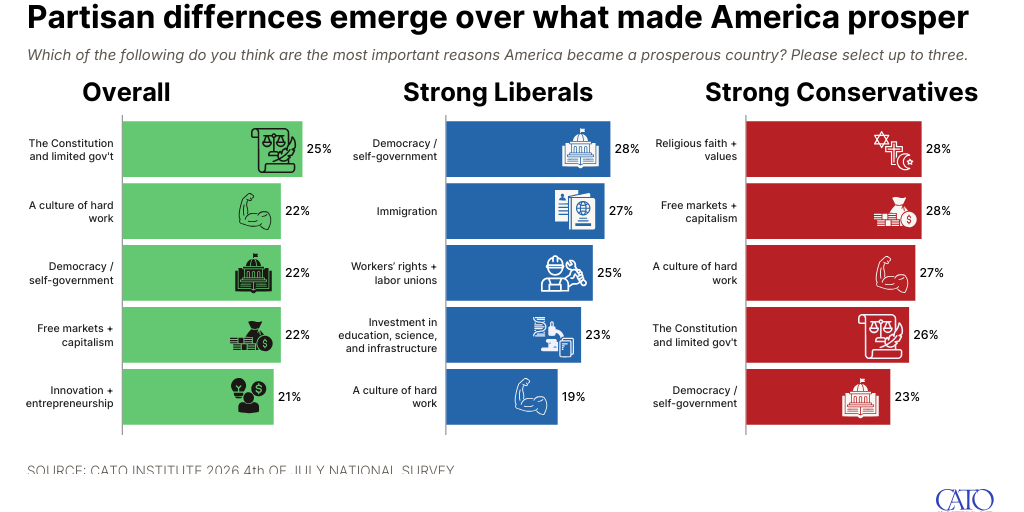
Partisans place slightly different emphases on which possible reasons matter most. For example, among strong liberals, their top explanations for American prosperity include democracy (28%), immigration (27%), workers’ rights and labor unions (25%), government investment in education, science, and infrastructure (23%), and innovation and entrepreneurship (23%). Among strong conservatives, their top explanations were free markets and capitalism (28%), religious faith and values (28%), a culture of hard work (27%), and the Constitution and limited government (26%).
Americans Still Believe in Constitutional Restraint
Separation of Powers
The survey found that a majority of Americans still support the idea of separation of powers enshrined in the Constitution. Nearly two-thirds (61%) say it’s better “when political power is divided among different branches of government, even if that sometimes makes it harder for the government to act quickly.” About a fifth say it’s better for the government to act quickly and decisively, even if that sometimes means giving leaders more power (19%), and 21% aren’t sure which of these they agree with more.
Executive Power
A majority (61%) of Americans believe that Congress gives too much of its lawmaking power to the president and federal agencies. But when asked what the best way to make public policy was, only a plurality (45%), albeit not a majority, said that Congress should pass a bill and the president sign it into law; 11% said the president should issue an executive order; 28% said it depends; and 16% weren’t sure.
Notably, nearly 4 in 10 Americans (38%) say they find it acceptable for a president they supported to “stretch” the Constitution to accomplish something they agreed with, while 39% say it is unacceptable, and 24% aren’t sure.
However, a strong majority draws the line at Supreme Court rulings. Nearly three-fourths (72%) of Americans say the president should have to obey Supreme Court rulings, even when he believes the court is wrong. Majorities of Democrats (81%) and Republicans (68%) agree.
Supreme Court
About a third of Americans support expanding the number of Supreme Court justices from 9 to 13; 31% are opposed, and 33% don’t know enough to say. A slim majority (51%) of Democrats support expanding the number of justices compared to 37% of Republicans and 23% of independents.
Principle Over Party
A solid majority of Americans (58%) say no political party should be trusted with too much power. About a quarter (23%) say their preferred political party can be trusted with more power than the opposing party. Democrats (62%) are somewhat more likely than Republicans (54%) to agree that no political party should be entrusted with too much power.
Purpose of government
The survey investigated how attitudes toward the purpose of government have changed over time. At the time of the nation’s founding, many of the founders would say the main purpose of government was to protect people’s rights and freedom. Over time, however, many Americans came to view a more expansive role for government to solve major social and economic problems. Today, about a third of Americans (36%) believe the main purpose of government is to protect people’s rights and freedoms, and 43% say its purpose is to both protect freedom and solve major social and economic problems, and 10% say its primary job is to solve problems. The remaining 12% aren’t sure either way. This demonstrates that a large share of the population does not believe there is a contradiction between the government attempting to solve major social and economic problems while also protecting Americans’ rights and freedoms.
Significant Knowledge Gaps Exist about Nation’s Founding
The survey included a short civics quiz to assess public knowledge of the country’s founding. Americans were aware of some basic facts but lacked understanding of the substance and context of what established our system of government.
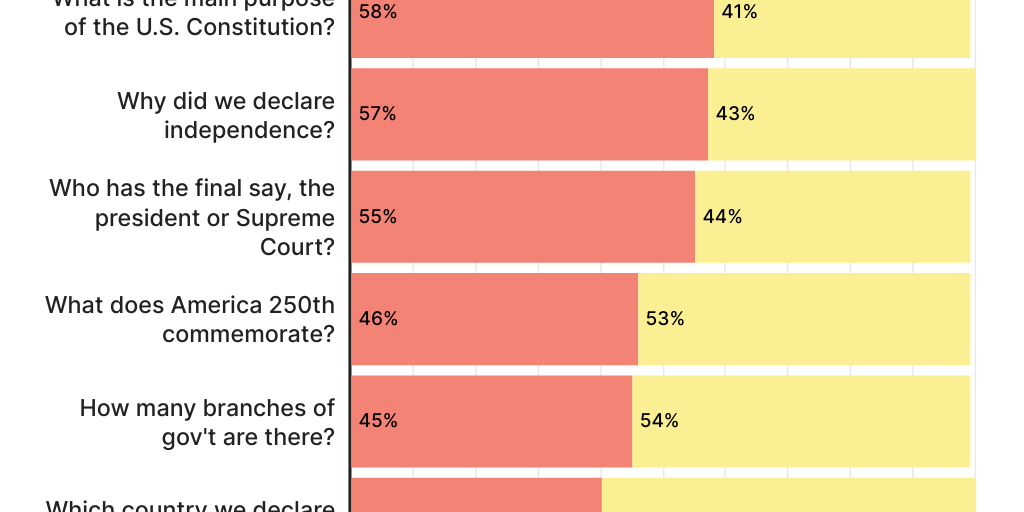
A majority (61%) of Americans correctly said that the 13 original colonies declared their independence from Great Britain, while 4 in 10 answered incorrectly. A majority also correctly identified George Washington as the country’s first president, while 22% did not give the correct answer. A slim majority (54%) correctly said that the US Constitution creates 3 branches of government, while 45% answered incorrectly.
- To the best of your knowledge, which country did the original 13 American colonies declare their independence from?
- Great Britain 61%
- Incorrect Answer: 40%
- Europe 4%
- Canada 3%
- France 4%
- Spain 2%
- Germany 2%
- Not Sure 25%
- To the best of your knowledge, who was the first president of the United States?
- George Washington 77%
- Incorrect Answer: 22%
- Thomas Jefferson 2%
- John Adams 1%
- Abraham Lincoln 5%
- King George III 1%
- Not Sure 13%
- To the best of your knowledge, how many branches of government does the US Constitution create?
- Three Branches: 54%
- Incorrect Answer: 45%
- Two 6%
- Four 10%
- Five: 4%
- Not Sure: 25%
However, majorities did not know why we declared independence from Britain, what the main purpose of the Constitution is, or who actually has the final say when the President and the Supreme Court disagree.
-
57% of Americans don’t know why the American colonies declared independence from Britain in 1776; only 43% knew it was to protest high taxes and lack of representation in government
-
58% of Americans don’t know that the main purpose of the U.S. Constitution was to establish and limit the powers of the federal government; 41% answered correctly
-
55% don’t know that the Supreme Court has final say when the President and the Supreme Court disagree about whether a president’s action is constitutional; 44% knew that the Supreme Court has final say.
Capitalism and Socialism
Capitalism (52%) is viewed somewhat more favorably than socialism (37%) among Americans generally. But people are evenly divided on socialism, with equal shares who are favorable (37%) as unfavorable (37%). A fifth (21%) have a favorable view of communism.
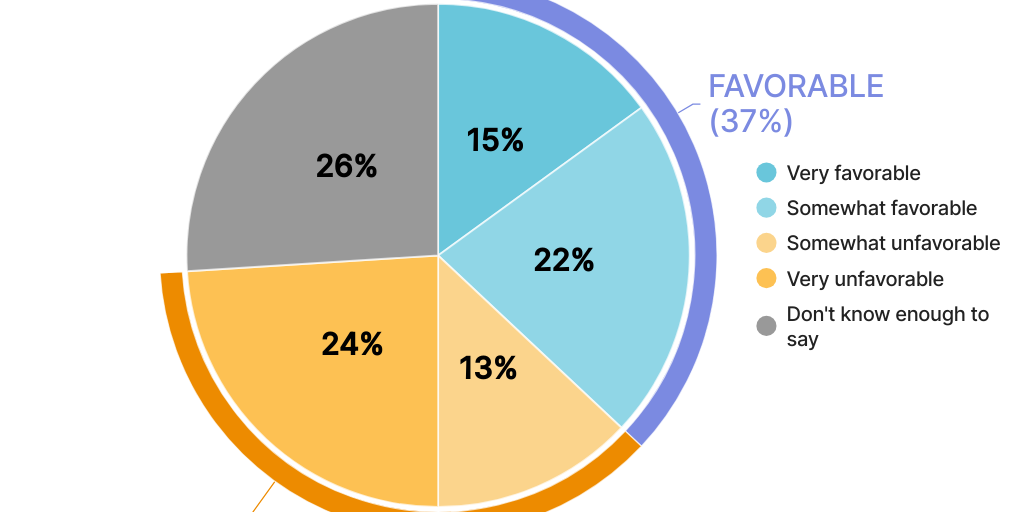
Gen Z stands out for having more people who like socialism (53%) than capitalism (45%). More than a third of Americans under 30 (38%) say they have a favorable view of communism. This means that nearly as many Gen Z Americans have a favorable view of communism (38%) as capitalism (45%). Moreover, Gen Z is the only age group with a more favorable than unfavorable view of communism (38% favorable, 36% unfavorable).
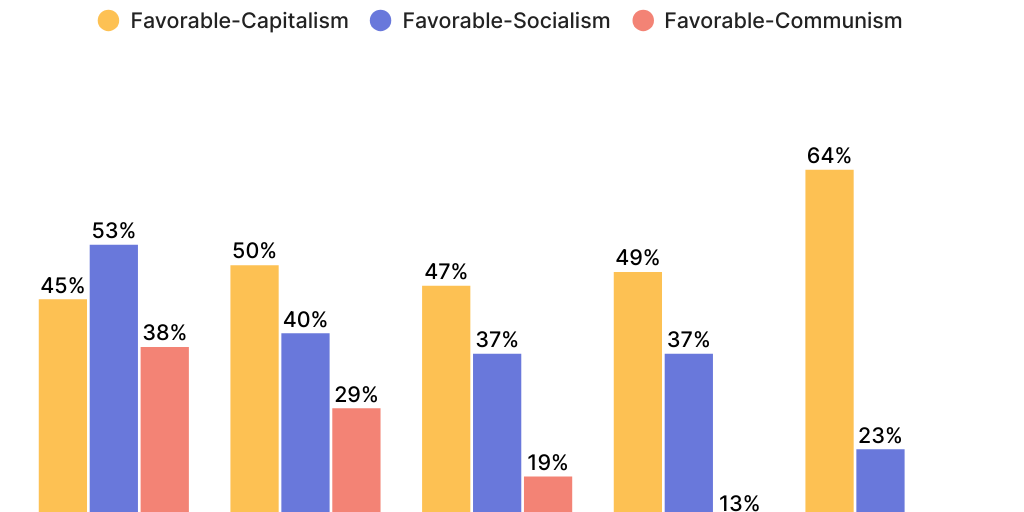
Each successive generation becomes less supportive of socialism and communism and somewhat more supportive of capitalism. For instance, while 53% of 18–29-year-olds like socialism, only 37% of 45–64-year-olds and 23% of seniors have a favorable view of it. And while 38% of Gen Z like communism, this drops to 29% among 30–44-year-old millennials, to 19% among 45–54-year-olds, to 13% among 55–64-year-olds, and only 5% among the nation’s seniors. Support for capitalism increases with successive generations, but less so: about half of Americans under 65 have a favorable view of capitalism compared to 64% among seniors.
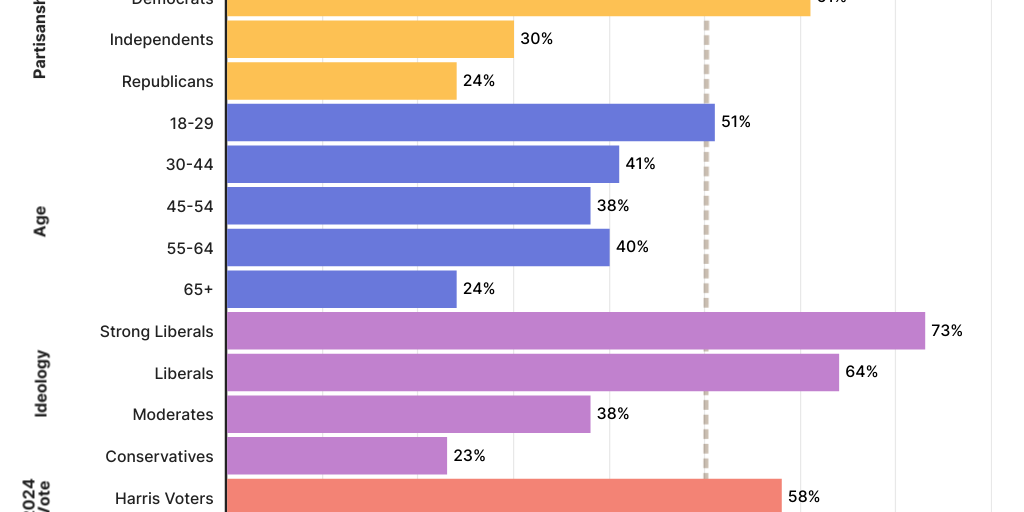
The survey also found the “Democratic Socialist” label can both help and harm a candidate. About 4 in 10 (39%) said they’d be more likely to vote for such a candidate, 40% said they’d be less likely, and 22% weren’t sure either way. Democrats (61%), Liberals (64%), and Gen Z (51%) reported they’d be more likely to vote for a candidate with the Democratic Socialist label. This helps illuminate recent wins by candidates using the Democratic Socialists of America label in Democratic primaries over the past few weeks.
Implications and Conclusion
As the United States approaches its 250th anniversary, Americans remain deeply attached to the country, its founding, and the freedoms it made possible. Large majorities say they are grateful and proud to be Americans, view the nation’s founding favorably, believe the Constitution remains important to protecting liberty, and continue to see America as a land of opportunity. These findings suggest that, despite political polarization and public frustration, the American founding still provides a broadly shared source of national identity.
Yet this attachment is paired with striking uncertainty and concern. Nearly half of Americans do not know what the 250th anniversary commemorates, and many lack basic knowledge about the Declaration of Independence, the Constitution’s purpose, and the structure of constitutional government. Many Americans value the Constitution instinctively but do not fully understand how it protects freedom: by establishing, dividing, and limiting government power. This civic knowledge gap is especially pronounced among younger Americans, who are less likely to feel connected to the founding and more likely to be uncertain or skeptical about the Founders and America’s future.
Majorities believe the country has moved away from its founding principles and worry that the United States could lose its freedom in the coming decades. Americans identify corruption, abuse of power, and politicians’ disregard for the Constitution as major threats to the republic. At the same time, most Americans continue to support constitutional restraint: they prefer divided power over unchecked speed, believe presidents should obey Supreme Court rulings, and say no political party should be trusted with too much power.
Taken together, these findings point to a public that is more constitutionally cautious than the political climate often suggests. Americans may disagree over policy and priorities, but many share a common concern that concentrated power, corruption, and declining civic character threaten self-government. They also broadly agree that freedom depends not only on institutions but on citizens who are honest, responsible, and committed to principles above party.
The 250th anniversary, therefore, presents an opportunity not merely to commemorate the past but to reconnect Americans, especially young Americans, with the meaning of the founding and the principles and habits necessary to sustain a free society. Americans want young people to learn that freedom is rare and must be protected, that patriotism means loyalty to the country’s principles rather than to any party or politician, and that America’s story includes both great achievements and serious injustices.
The central conclusion is that Americans still believe in the promise of the American founding, but they are uncertain whether the country is living up to it. The challenge for the next 250 years is to rebuild civic knowledge, restore trust in and recommit to constitutional limits, reduce corruption and special-interest influence, and cultivate the character and restraint required for a free people to govern themselves.
Methodology
The Cato Institute 2026 4th of July Survey was designed and conducted by the Cato Institute in collaboration with Morning Consult. MorningConsult collected responses online June 25–26, 2026, from a national sample of 2,253 Americans 18 years of age and older. The margin of error for the survey is ± 2 percentage points at the 95 percent level of confidence. Restrictions were put in place to ensure that only the people selected and contacted by Morning Consult are allowed to participate. A more comprehensive methodology description can be found in the topline and crosstab documents.
Full TOPLINES and METHODOLOGY for the survey can be found HERE, and CROSSTABS can be found HERE. Detailed tables can be found HERE.